Showing posts with label CAR. Show all posts

Tuesday, December 09, 2025

ICC sentences Sudan Janjaweed leader Ali Kushayb to 20 years for war crimes and crimes against humanity

Report from Deutsche Welle (DW)

By Sean Sinico with AP, AFP, dpa, Reuters

Dated Tuesday 9 December 2025 - full copy:


ICC sentences Sudan Janjaweed leader to 20 years in prison


Judges at the International Criminal Court sentenced a leader of the Sudanese Janjaweed militia in Darfur to 20 years in prison. Muhammad Ali Abd Al-Rahman was convicted of war crimes and crimes against humanity.


Over 300,000 people died and millions were displaced by the conflict in Darfur in the early 2000s [FILE: September 2004]. 
Image: Scott Nelson/Getty Images


Ali Muhammad Ali Abd-Al-Rahman, also known as Ali Kushayb, on Tuesday received a joint sentence of 20 years in prison by the International Criminal Court, following his conviction on 27 counts of war crimes and crimes against humanity. 


Presiding Judge Joanna Korner said Abd-Al-Rahman "not only gave the orders that led directly to the crimes" in attacks that largely targeted members of the Fur tribe seen to support a rebellion against Sudanese authorities, he "also personally perpetrated some of them using an ax he carried in order to beat prisoners."


First ICC conviction for war crimes in Darfur


Abd-Al-Rahman was the first person convicted by the ICC for atrocities in Sudan's Darfur region. Judges ruled that crimes committed by the Janjaweed militia were part of a government plan to stamp out a rebellion there.


In the sentencing summary, Korner cited testimony from victims of the Janjaweed: "Days of torture began at sunrise and continued until forced displacement, brutal beatings, and rape, both inside homes and in public, in full view of the police. … Ali himself walked over the heads of people lying face down on the ground … Blood ran freely in the streets... there was no medical help, no treatment, no mercy."


Ali Muhammad Ali Abd-Al-Rahma, seen here at the ICC, committed crimes of 'unimaginable cruelty,' the presiding judge said. Image: Peter Dejong/ANP/picture alliance


Key facts about the conflict in Darfur

  • Fighting began in Darfur in 2003, when mostly non-Arab rebels took up arms against the Sudanese government, accusing it of marginalizing the remote western region.
  • The government mobilized Arab militias, known as the Janjaweed, to crush the rebellion.
  • The UN has said 300,000 people were killed and 2.5 million more displaced.
  • The US and human rights groups said the violence amounted to genocide.
Crimes were 'the stuff of nightmares'

Prosecutors had requested a life sentence for Abd-Al-Rahman and could appeal the sentence and renew their call for a life term.


"You literally have an axe murderer before you," Prosecutor Julian Nicholls had told the court. "This is the stuff of nightmares."


Abd-Al-Rahman's defense argued he was a victim of mistaken identity and that his age of 76 years meant any sentence longer than seven years would amount to a life term.


Abd-Al-Rahman fled Sudan for the Central African Republic in 2020 when a new government said it would cooperate with the ICC's investigation. He later surrendered to authorities, a move Korner said contributed to a lower sentence along with his age and good behavior while in detention. Abd-Al-Rahman's time in detention, both before and during his trial, will be deducted from the sentence.


The ICC, which tries individuals for the world's worst crimes, can impose a life sentence but has never done so.


View original: https://www.dw.com/en/icc-sentences-sudan-janjaweed-leader-to-20-years-in-prison/a-75077572

Ends 

Thursday, March 13, 2025

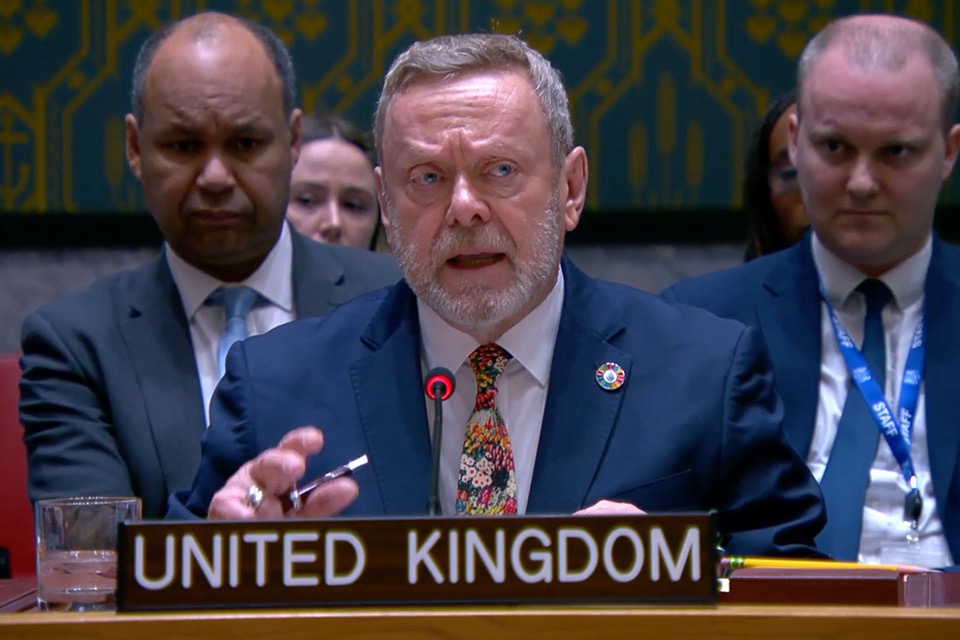
UK statement at UNSC: In April, UK's Foreign Secretary will convene FM's in London to help end Sudan conflict and improve humanitarian response

HERE is a speech by UK's Lord Collins of Highbury, Minister for Africa and the UN, at the UN Security Council meeting on Sudan held 13 March 2025.

Note, fighting in Sudan has displaced approximately 12.8 million people, roughly 3.7 million of whom have sought refuge in Sudan’s neighbouring countries—the Central African Republic (CAR), Chad, Egypt, Ethiopia, Libya, South Sudan, and Uganda. Read more in report from What's in Blue below.

In April, the UK’s Foreign Secretary will convene Foreign Ministers in London to help end the conflict and to improve the humanitarian response.
______________________________

Published: Thursday 13 March 2025
Speech location: United Nations, New York
Delivered on 13 March 2025 (Transcript of the speech, exactly as it was delivered) - full copy:

Greater international action is needed to tackle widespread sexual violence in Sudan: UK statement at the UN Security Council


Statement by Lord Collins of Highbury, Minister for Africa and the UN, at the UN Security Council meeting on Sudan.

Thank you to our briefers UNICEF and MSF. 


As you have made clear, women and girls in Sudan continue to face the worst horrors of this conflict.


Almost two years since the fighting began, more than 12 million people are now at risk of sexual and gender-based violence, according to UNICEF reports. 


And Sudan’s healthcare system has been decimated by the conflict, making it even harder for survivors to access support.


The UK’s Foreign Secretary travelled to the Sudan-Chad border in January and met survivors of sexual violence who shared their harrowing stories of rape and torture.


And the Independent International Fact-Finding Mission for Sudan has reported that rape and gang rape is widespread in the context of the conflict in Sudan.


Acts of sexual violence constitute crimes under international law. 


And it is the responsibility of this Council to act.


President, it is clear that greater international action is needed to tackle widespread sexual violence in Sudan. The United Kingdom is committed to playing its part.


This week I joined a meeting of the International Alliance on Preventing Sexual Violence in Conflict, convened by Ukraine, to discuss the urgent need for joined-up, survivor-centred responses.


Through the UK-funded Women’s Integrated Sexual Health programme, we are providing sexual and reproductive services to women and children in Sudan.


We are also working with UN and NGO partners to provide safe spaces, mobile clinic treatment, dignity kits and psycho-social services for survivors.


But to have most impact, it is important that the international community comes together to address sexual violence in Sudan by taking 4 key steps.


First, by continuing to press the warring parties to comply with the commitments they made to protect civilians in the Jeddah Declaration.


Second, by giving support to civil society organisations on the ground who are playing a crucial role in assisting survivors of sexual violence.


Third, by supporting the International Criminal Court and the UN Fact-Finding Mission to carry out impartial investigations.


And fourth, by ensuring that the protection of civilians remains at the top of this Council’s agenda.


President, looking ahead, in April, the UK’s Foreign Secretary will convene Foreign Ministers in London to help end the conflict and to improve the humanitarian response.


Bringing an end to the conflict will be a critical step towards ending sexual and gender-based violence in Sudan.


Colleagues, we must continue working together closely until we achieve that goal.


View original: https://www.gov.uk/government/speeches/greater-international-action-is-needed-to-tackle-widespread-sexual-violence-in-sudan-uk-statement-at-the-un-security-council

______________________________


Related


Report from What's In Blue 

Dated Wednesday 12 March 2025

Sudan: Briefing


Nearly two years into the war, which started on 15 April 2023, Sudan has witnessed a devastating humanitarian crisis, resulting in significant civilian casualties, mass displacement, and acute food and water shortages. 


The crisis has also been marked by a collapse of healthcare and essential services and grave violations of international humanitarian law, including widespread incidents of CRSV.


The fighting has displaced approximately 12.8 million people, roughly 3.7 million of whom have sought refuge in Sudan’s neighbouring countries—the Central African Republic (CAR), Chad, Egypt, Ethiopia, Libya, South Sudan, and Uganda.


Full story: https://www.securitycouncilreport.org/whatsinblue/2025/03/sudan-briefing-5.php


End

Friday, February 09, 2024

The three guises of RSF terrorist group leader Hemeti

Report from Radio Dabanga website
Dated Thursday, 8 February 2024, 13:17 - here is a copy in full:

Sudan war: Hemedti laments human suffering amid daily RSF attrocities

The commander of the paramilitary Rapid Support Forces (RSF), Lt Gen Mohamed ‘Hemedti’ Dagalo, has issued an “urgent call to the international community on the humanitarian crisis in Sudan”. Hemedti’s appeal has been met with cynicism amid widespread daily reports of rape, assault, and theft by RSF militiamen, ‘wreaking havoc’ in Darfur and other parts of Sudan that fall under the militia’s control.


In a lengthy statement posted on X (formerly Twitter) today, Hemedti points out: “Sudanese civilians find themselves in dire circumstances, facing the real possibility of starvation. This situation necessitates prompt action from regional and international organisations and agencies to provide urgent relief”.


In his statement, the RSF commander asserts that the war in Sudan, that broke out in April last year, “[was] ignited by remnants of the former regime and their allies within the Sudan Armed Forces (SAF).” He highlights that “the situation has deteriorated significantly, culminating in a famine in certain areas of the country”, and that “Sudanese civilians find themselves in dire circumstances, facing the real possibility of starvation.” He calls on “prompt action from regional and international organisations and agencies to provide urgent relief”.

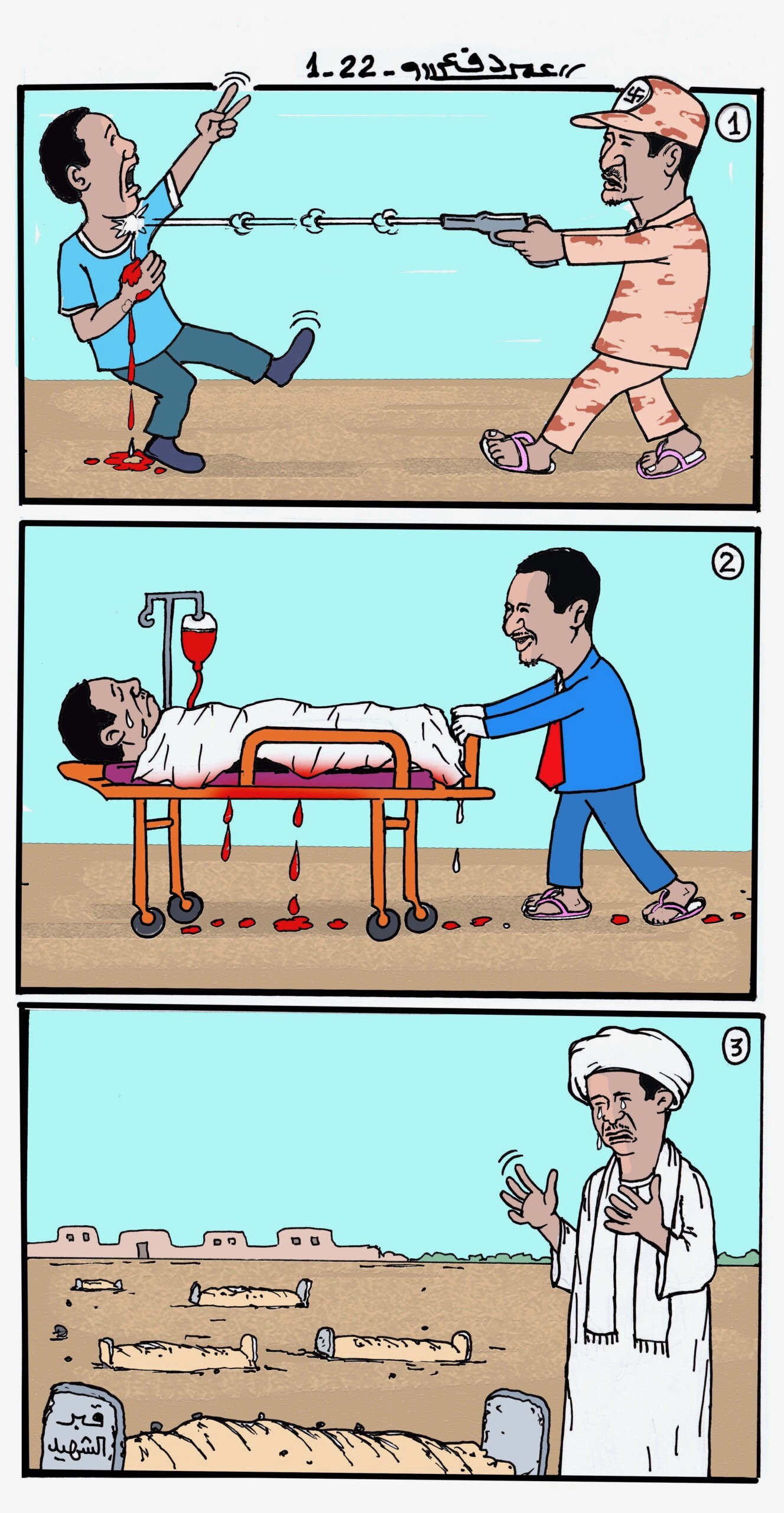
"The three guises of  of RSF terrorist group leader Hemeti

Caption by Sudan Watch Editor 

Cartoon by Omar Dafallah / Radio Daganga


However, as previously reported by Radio Dabanga, mounting allegations from Sudan indicate that the RSF is part of the problem, rather than part of the solution. Marauding members of the paramilitary Rapid Support Forces (RSF) are reportedly “wreaking havoc“ among civilians in parts of Sudan under the militia’s control. While individual incidents are often hard to verify, reports reaching Radio Dabanga show a clear pattern of widespread banditry, including murder, robbery, and sexual violence.


Humanitarian catastrophe


International aid organisations have long lamented the humanitarian catastrophe befalling Sudanese civilians, and a group of UN experts reported last week that “about 25 million people, including 14 million children, are in dire need of humanitarian assistance in Sudan”.


In today’s post on X, Hemedti says that the RSF “reaffirm our steadfast commitment to working with all international partners to facilitate the unrestricted delivery of humanitarian aid in Sudan, ensuring the welfare and safety of affected populations and humanitarian workers.”


However, as a few respondents voiced support for the RSF, most reactions scorned Hemedti’s remarks. “You are the main reason for war. You should be sent to International Criminal Court immediately for all crimes in Sudan,” says ‘Shadia’. In another response, ‘Sogra’ says: “RSF (Janjaweed) are responsible for the suffering of the Sudanese people. RSF started a war against Sudanese people and their army. RSF (Janjaweed) soldiers and leaders are criminals.”


UN relief


Yesterday, the United Nations and its partners appealed for a combined $4.1 billion to meet the most urgent humanitarian needs of civilians in war-torn Sudan and those who have fled to neighbouring countries.


A joint statement by the UN Office for the Coordination of Humanitarian Affairs (OCHA) and the UN refugee agency (UNHCR), pints out: “Ten months since the conflict erupted, half of Sudan’s population – some 25 million people – needs humanitarian assistance and protection. More than 1.5 million people have fled across Sudan’s borders to the Central African Republic, Chad, Egypt, Ethiopia and South Sudan.”


The UN Office for the Coordination of Humanitarian Affairs (OCHA) coordinates the response inside Sudan, with this year’s Humanitarian Needs and Response Plan calling for $2.7 billion to reach 14.7 million people. UNHCR, the UN Refugee Agency, coordinates the Regional Refugee Response Plan, which requests $1.4 billion and targets nearly 2.7 million people in five countries neighbouring Sudan.


See the RSF commander Hemedti’s complete statement here.

See the joint OCHA and UNHCR statement here.


View original: https://www.dabangasudan.org/en/all-news/article/sudan-war-hemedti-laments-human-suffering-amid-daily-rsf-attrocities


END

Friday, December 22, 2023

UN Deputy Humanitarian Coordinator Sudan (Darfur) Toby Harward says vital aid needed in Darfur quickly

THIS copy of a Dec 20, 2023 post at X published by UN Deputy Humanitarian Coordinator Sudan (Darfur) Toby Harward @tobyharward says: "Latest clashes in El Fasher & Nyala, Darfur, result in more displacement with new refugees crossing into Chad, & Salamat/Habbaniya inter-communal conflict displacing more than 15,000 persons to Chad & CAR border areas. Um Dukhun already hosts more than 80,000 IDPs & refugees. Imperative that aid reaches this corner of Darfur quickly."
____________________________

Postscript from Sudan Watch Editor:
El Fasher is in North Darfur State. Nyala is in South Darfur State. Um Dukhun is in Central Darfur State. This map 'Darfur Conflict Zones and Refugee Camps' is undated. Central Darfur State is a state in south-western Sudan, and one of five comprising the Darfur region. It was created in January 2012 as a result of the ongoing peace process for the wider Darfur region. Its state capital is Zalingei. The state was formed from land that had been part of the states of West Darfur and South Darfur. Abeche is in Chad.
ENDS

Friday, December 15, 2023

South Sudan named in most dangerous countries to visit - “security” highest warning level of “extreme”

Report from The Independent - independent.co.uk/news/world
By Helen Coffey
Dated Friday, 15 December 2023 - here is a copy in full:

World’s most dangerous countries to visit in 2024 revealed

Lebanon, Palestinian Territories and Russia have all seen notable risk rating increases


The world’s most dangerous countries to visit in 2024 have been revealed in a new study.


South Sudan, Afghanistan, Syria, Libya and Somalia were named as the riskiest nations in the 2024 risk map compiled by medical and security consultancy International SOS.


The annual map assesses various factors to inform travellers and businesses about potential threats in countries across the globe.

It pulls together medical and security risk ratings, reflecting the impact of events such as the ongoing conflicts in Ukraine and between Israel and Hamas.


This year, for the first time, the map also includes ratings based on the dangers of climate change, after International SOS saw a rising trend in the number of climate-related alerts being issued to clients as rising global temperatures increased health risks around the world.


The data, compiled by Inform (a collaboration between the Euro-Mediterranean Center on Climate Change and Joint Research Centre of European Commission), estimates the future risk of humanitarian crises and disasters caused by climate change.


“Just one example, the extreme heat events this year, with the first ever named heatwave Cerberus hitting Europe, may become commonplace,” said Dr Irene Lai, global medical director at International SOS.


“In addition to the physical impacts of extreme heat, there can be significant negative effects on mental health. It is essential businesses plan for this, adapting our way of living and working to protect health, while also taking steps to slow and eventually reverse the trend in rising temperatures.”


Countries were graded for each category of risk – medical, security and climate change – on a five-level scale ranging from “low” to “very high” for medical and climate change, and “insignificant” to “extreme” for security.


For “security”, Ukraine, Syria, Iraq, Afghanistan, Libya, Yemen, South Sudan, Central African Republic and Somalia were all given the highest warning level of “extreme”.


Parts of Lebanon, Palestinian Territories, Russia and across the Sahel all saw increases in security risk, alongside Ecuador and parts of Colombia following a rise in criminality and unrest.


View original: https://www.independent.co.uk/travel/news-and-advice/most-dangerous-countries-world-2024-b2464568.html


END