Showing posts with label Camps Chad. Show all posts

Thursday, July 09, 2026

International Criminal Court has "concrete evidence" linking RSF leaders to war crimes in Darfur, Sudan

"The International Criminal Court (ICC) has "concrete evidence" linking leaders of the paramilitary Rapid Support Forces (RSF) to recent war crimes in the Sudanese state of Darfur, the ICC's deputy chief prosecutor says.


Nazhat Shameem Khan told the BBC the ICC had reached a "breakthrough" in its investigation into the massacres of civilians in the cities of el-Fasher and el-Geneina." Read full story.


From BBC News

By Thomas Mukhwana

Africa correspondent

Published Thursday 09 July 2025 - full copy:


International court tells BBC of breakthrough in Sudan war crimes probe

IMAGE SOURCE, AFP VIA GETTY IMAGES 
Image caption, Tens of thousands of people fled el-Fasher after the city was seized by the Rapid Support Forces (RSF)

The International Criminal Court (ICC) has "concrete evidence" linking leaders of the paramilitary Rapid Support Forces (RSF) to recent war crimes in the Sudanese state of Darfur, the ICC's deputy chief prosecutor says.


Nazhat Shameem Khan told the BBC the ICC had reached a "breakthrough" in its investigation into the massacres of civilians in the cities of el-Fasher and el-Geneina.


"It may take time for justice to develop, to be brought to the court, but we will get there," Khan said, adding that RSF leaders have also been linked to crimes against humanity.


The siege and takeover of el-Fasher marked one of the bloodiest episodes in the ongoing war between the RSF and Sudan's army.


More than 6,000 people were killed in el-Fasher as the RSF seized the city in October last year, the United Nations says, while the paramilitary group is accused of carrying out a similar massacre in el-Geneina.


The group has repeatedly denied carrying out widespread killings anywhere in Darfur.


Khan said: "We have now found concrete evidence that links what is happening on the ground through linkage evidence to specific persons in leadership mode."


However, she did not give a timeline on when charges might be brought against those responsible for the atrocities in the war, which began in April 2023.


"We cannot say how quickly or how long it's going to take," she said.


"But we can say that progress has been significant and that we have achieved a breakthrough."


The ICC, based in the Dutch city of The Hague, is a global court with the power to bring prosecutions for genocide, crimes against humanity and war crimes.


Khan spoke to the BBC after visiting refugee camps in eastern Chad, where those who had fled the fighting in Darfur told her of the atrocities they had suffered.


Tens of thousands of people were forced to leave their homes in el-Fasher and the UN said the violence there bore the "hallmarks of genocide".


The RSF has denied widespread allegations that killings in the city were ethnically motivated and follow a pattern of the Arab paramilitaries targeting non-Arab populations.


The group insisted the scale of the atrocities had been exaggerated but acknowledged that some violations had occurred in the city.


Shortly after the capture of el-Fasher, RSF leader Gen Mohamed Hamdan Dagalo said the group was investigating any atrocities. The probe is ongoing, the RSF said recently.

The ICC has been investigating allegations of war crimes in Darfur for more than 20 years since the previous round of violence in the 2000s.


"What we see is patterns of offending that in fact were the same patterns of offending 20 years ago when this situation was first referred to us by the Security Council," she said.


Khan said the ICC investigation included witness accounts, testimonials and corroborative evidence such as videos, photographs and forensic evidence.


Previous investigations have led to seven arrests and six separate cases being brought before the court for alleged war crimes and crimes against humanity.


Those charged include Sudan's former President Omar al-Bashir.


He remains at large, having been ousted in a coup in 2019. It is believed he is being held in a secure medical facility in Sudan.


Four others face arrest warrants but have not been detained.


Last year, the ICC sentenced one former militia leader to 20 years in prison after he was successfully convicted of 27 counts of war crimes and crimes against humanity, committed in Darfur from 2003 to 2004.


Ali Muhammad Ali Abd-Al-Rahman was a senior figure in the Janjaweed, a government-backed group which targeted Darfuri civilians who were not part of country's majority Arab population.


The Janjaweed was one of the groups which developed into the RSF, a paramilitary force once aligned with Sudan's army, but which it is now fighting.


View original: https://www.bbc.co.uk/news/articles/c9928zr2m5xo

Ends  

Tuesday, January 16, 2024

Sudan: 500,000 Sudanese refugees in Chad in dire need of aid. Testimonies recount unspeakable horrors

“Testimonies recount unspeakable horrors - family members killed, women enduring heinous acts of abduction and sexual violence, and homes reduced to ashes. Despite the tireless efforts of humanitarian organisations and the welcoming gestures from the host communities and the government of Chad, the situation is close to catastrophic.” -Stephen Cornish, MSF Director General 

“They told us that this wasn’t our country and gave us two options: immediately leave for Chad or be killed. They took some men and I saw them shooting them in the streets, with no one to bury the corpses.” -H., A refugee who fled to Adre from El Geneina X


Source: Médecins Sans Frontières (MSF) aka Doctors Without Borders

Statement by Stephen Cornish, MSF Director General 

Dated 22 December 2023 - here is a copy in full:


Half a million Sudanese refugees in Chad in dire need of humanitarian aid

This week, I visited the camps in eastern Chad to witness the living conditions of Sudanese refugees. 


I have worked as a humanitarian worker in countries across the globe, but what I saw in Chad in this emergency has shocked me to my core.


With such a rapid and vast displacement of people fleeing harrowing violence, the overwhelming nature of how many people have sought refuge here and knowing what made them flee is really hard on the heart.

So many people seeking refuge in the desert are relying on humanitarian aid, which is inadequate and sporadic. This cannot go on. 


Despite the tireless efforts of humanitarian organisations and the welcoming gestures from the host communities and the government of Chad, the situation is close to catastrophic.

From insufficient access to food, water and shelter, to concerns about proper hygiene, it’s a daily struggle for those who have left almost everything behind. Approximately 150,000 individuals in Adre transit camp and the surrounding areas live week to week, navigating through precarious conditions to survive.  


The limited food distributions happen irregularly and the amount distributed typically lasts only a couple of weeks. On top of that, not everyone is receiving these distributions.

In Adre, there’s one latrine for 300 to 400 people - far below the recommend standards. Despite tremendous efforts put forth by Médecins Sans Frontières (MSF) and local partners, delivering half a million litres of water daily, refugees only receive between six to eight litres per day.


People don't have enough water to bathe, to clean, or to cook. They don’t have suitable jerry cans in order to be able to collect and store water properly.

We've already seen a very high incidence of malnutrition, as well as high numbers of people suffering from diarrhoea and malaria. Speaking with the doctors here this week, the number of cases of malaria has decreased but it is still widespread.  


Our role now is to ensure enough assistance together with other partners going forward so we don't end up in another catastrophic situation several months down the road. Today, people can survive for the next couple of months, but what will happen after that?  

An elderly person collects water from a distribution point. Refugees here only receive between six to eight litres per day for drinking, bathing, cooking and cleaning. Chad, 7 December 2023. 

RENAUD MASBEYE/MSF


There are many organisations here on the ground, but they don't have the financial resources to meet the needs of the people. So, we need governments, we need donor countries to help organisations on the ground to scale up and meet the emergency needs, from shelter to water to food.  


The people suffering in this crisis are predominantly women and children, while many are also victims of large-scale violence.


Their testimonies recount unspeakable horrors - family members killed, women enduring heinous acts of abduction and sexual violence, and homes reduced to ashes. Their sole aspiration is to find a safe haven in Chad and be able to live in decent and dignified conditions.  


These people, relocated in the desert, cannot face this ordeal alone. This cannot be put aside and forgotten as just another crisis. Solid and sustained humanitarian commitments, and an urgent scale up of aid efforts on the ground are urgently required to avoid a catastrophic crisis and large-scale misery in the months to come. 


View the original report:

English  https://www.msf.org/half-million-sudanese-refugees-chad-dire-need-humanitarian-aid

Arabic https://www.msf.org/ar/نصف-مليون-لاجئ-سوداني-في-تشاد-في-حاجة-ماسة-للمساعدات-الإنسانية

Explore accessibility options


ENDS

Monday, January 15, 2024

MSF Sudan: Severe humanitarian needs after half a million people flee violence in Wad Madani, Aj Jazhira

“Because of the violent clashes and the crisis... we went to Khartoum. But the war followed us to Khartoum, so we went to Wad Madani. And then, the story continues.” -Maha, a displaced woman in Tanideba camp X


Report from Médecins Sans Frontières (MSF) aka Doctors Without Borders

Project Update 

Dated Monday, 15 January 2024 - here is a copy in full:


Severe humanitarian needs after half a million people flee violence in Wad Madani

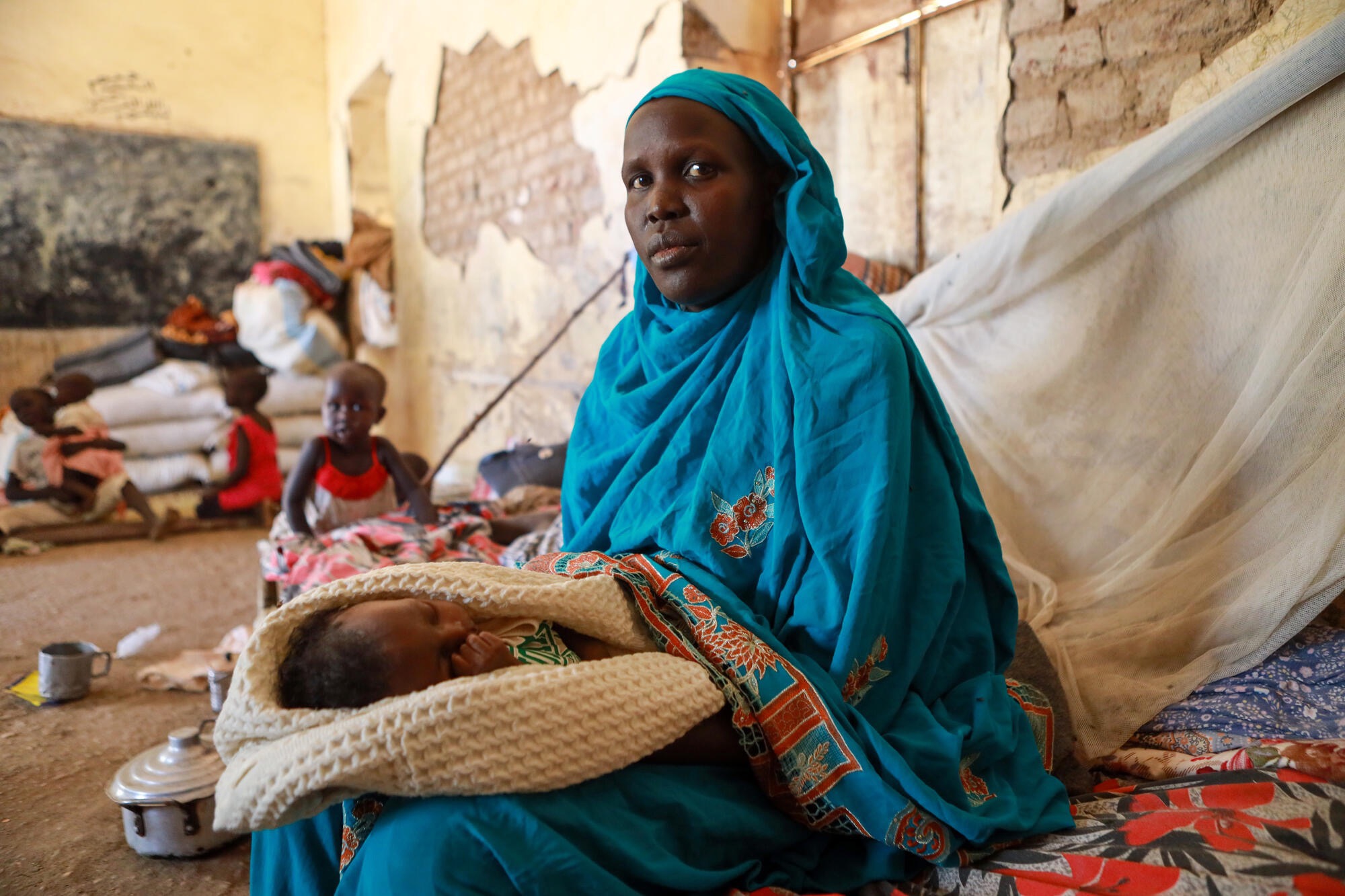
A displaced woman holds her child as she takes refuge in Alsafat Camp in Al Jazirah state. “I'm worried about the future of my children. I'm thinking about returning to Abyei so that I could provide an education for my children. But if the war comes to an end I'll return to Khartoum and my house as soon as possible, and my husband will be able to work,” she says. Sudan, December 2023. © FAIS ABUBAKR X


On 15 December, the Rapid Support Forces (RSF) launched an attack on Wad Madani, Sudan, and took control of several other cities and areas in Al Jazirah state within days. Since then, more than half a million people have fled the fighting and insecurity, including about 234,000 displaced people who had previously sought refuge in Wad Madani as violence in Khartoum intensified.  


The chaos following the evolving conflict and the severe insecurity and widespread violence created an environment in which Médecins Sans Frontières (MSF) could no longer operate in Wad Madani. 


As a result, we had to suspend all activities and evacuate our staff from Wad Madani on 19 December, leaving behind people with even less access to basic medical services. We also had to evacuate staff from Damazine, Um Rakuba in Gedaref state, and Doka. In Damazine, we reduced activities.


Our teams had been present in Wad Madani since May 2023. Conditions were already dire for the half a million displaced people living there, which made up 8 per cent of all internally displaced people in Sudan. Sudan was already home to the world’s largest internal displacement crisis, with more than six million people forced from their homes within the country in addition to more than 1.4  million who have fled across borders. 


Between May and November, our teams performed 18,390 medical consultations (40 per cent of them for children under 15 years old) in several of the hundreds of locations hosting displaced people across the state of Al Jazirah, some in schools or old public buildings.  


Through our mobile clinics, our teams diagnosed and referred 66 children suffering from severe acute malnutrition with serious complications in the past six months – cases that could be fatal if not treated in a hospital urgently.

Sarah Deink holds her child as they take refuge in Alsafat Camp in Al Jazirah state. “I'm worried about the future of my children. I'm thinking about returning to Abyei so that I could provide an education for my children,” she says. Sudan, December 2023. FAIS ABUBAKR SHARE


“Health facilities were overwhelmed. As the number of people in the city had increased by 30 per cent, there were more and more patients, but considerable supply and staffing challenges,” says Slaymen Ammar, MSF medical coordinator for Sudan


“And as prices soared for all goods, access to lifesaving services was an obstacle for both displaced people and regular residents. Nowadays, with the departure of most international organisations – and despite efforts from local volunteer health workers – we can only assume it has worsened.” 


During the past month, in Gedaref and Kassala states – where we have been operational since 2021 in response to the Ethiopian Tigray crisis – MSF teams witnessed the arrival of thousands of people from Wad Madani, and are currently assessing and responding to the escalating health and humanitarian needs. 


In Tanideba (Gedaref), we have started a short-term emergency intervention for newly displaced Ethiopian refugees and newly displaced Sudanese citizens, covering basic healthcare, water and sanitation, as well as food rations. This included one-off distributions and donations. However, activities in Tanideba were temporarily reduced due to the escalation of conflict in Wad Madani.


AL BAKRI AL TAHER MALIK, A DISPLACED MAN FROM KHARTOUM, HAS BEEN INJURED TWICE BY THE FIGHTING IN SUDAN. 

“The war brought nothing but destruction and the separation of families. We lost our home, and we lost our city Khartoum. I lost my nephew. He died on the first day of Ramadan by a shell. He was divided into three parts.”

Al Bakri Al Taher Malik sits in a shelter for displaced people in Wad Madani, Al Jazirah state. He has been injured and displaced multiple times due to the conflict in Sudan. Sudan, December 2023. 
© FAIS ABUBAKR

The conflict in Sudan has caused immeasurable suffering, displaced millions, killed thousands, and injured countless others. For many displaced people, Gedaref and Kassala are just the latest stops in a long journey to seek safety, during which they have suffered violence and been without basic items, such as food, clean water, sanitation and access to medical care.  


“We are originally from Darfur, but because of the violent clashes and the crisis over there, we went to Khartoum. But the war followed us to Khartoum, so we went to Wad Madani. And then, the story continues,” says Maha*, a displaced woman who arrived with her family in Tanideba camp two weeks ago from Wad Madani.


Maha and her family fled Khartoum eight months ago, after shelling hit their home and severely injured one of Maha’s children.  


“We were six people in the house, and at that time I was nine months pregnant. Our house was destroyed. I was hit on my arm, but my child got a much worse injury on his head,” says Maha. 


“We managed to take him to the hospital because he needed urgent lifesaving surgery. But as soon as he was discharged, we had to flee the city because of insecurity. We arrived to the camp in Wad Madani, and I delivered there,” she says.


MARRY MONGA AND HER CHILDREN WERE FORCED TO FLEE THEIR HOME IN KHARTOUM.

“My baby is one-month old, but he doesn't look it because I don't have any milk. When I think about the future, I want my children to receive an education. I don't want my children to go through what we went through.”

Marry Monga sits with her one-month-old baby in Alsafat Camp in Al Jazirah state. She fled Khartoum on 15 May due to violence and insecurity there. Sudan, 12 December 2023. © FAIS ABUBAKR


In mid-December, Maha and her family fled once again to Tanideba.

“Clashes started and we began hearing sounds of fires and armed men fighting again. We decided to leave immediately. I started thinking about where we should go. Nowhere was safe at that time.” 


In a region where healthcare and essential medicine were already extremely limited, displaced people are now suffering from growing health demands, stemming from direct and indirect effects of violence. Basic needs are not being met and an urgent response is desperately needed.  


“At the gathering sites in Kassala city, people who have been displaced told our teams they haven’t received any assistance since their arrival in mid to late December,” says Pauline Lenglart, MSF emergency project coordinator in Sudan.  


“Families are sleeping on the ground, access to healthcare is still severely restricted, there are few working medical facilities and medicines aren't provided for free,” says Lenglart. 


“Many people have told us that they are unable to afford items like food and medicine, forcing them to choose between these necessities. Our team is constantly evaluating the needs at new sites that are opening to house recently displaced people. 


“In all these places, we see that the amount of humanitarian assistance provided is still woefully inadequate to meet people’s basic needs and ensure dignified living conditions,” says Lenglart. 


*Name changed to protect identity. 


View original, explore accessibility optionshttps://www.msf.org/sudan-severe-humanitarian-needs-after-half-million-people-flee-violence-wad-madani 

ENDS