NOTE from Sudan Watch Editor: One would hope passports are treated as respectfully as a nation's flag. You don't shred a nation's flag without it being interpreted as a terrible insult. This article doesn't make clear whether the passports destroyed by the US were in fact US passports. If not, it seems to me the passports were not their property to destroy. They should have left them behind safely. A country's border is man made. In today's age of digital technology losing a passport should not be a matter of life or death.
As rightly stated in the article: A passport is a “precious and lifesaving piece of property,” said Tom Malinowski, a former congressman from New Jersey who helped stranded Afghans in 2021. “It’s a big deal to destroy something like that, and when we do we have an obligation to make that person whole.”
Let's hope priority is given to replacing all passports wrongfully destroyed.
____________________________
Report at The New York Times
By Declan Walsh
Reporting from Nairobi, Kenya
Edward Wong contributed reporting.
Dated Friday 19 May 2023 - full copy:
Fleeing Sudan, U.S. Diplomats Shredded Passports and Stranded Locals
Officials destroyed Sudanese passports on security grounds as they evacuated the Khartoum embassy. Now the passport owners are trapped in a war zone.
Image Sudanese army soldiers guard a checkpoint in Khartoum on Thursday. Credit Agence France-Presse — Getty Images
In the frantic days before American diplomats evacuated their Khartoum embassy under darkness by helicopter last month, one crucial task remained.
Armed with shredders, sledgehammers and gasoline, American officials, following government protocols, destroyed classified documents and sensitive equipment, officials and eyewitnesses said. By the time Chinook helicopters carrying commandos landed beside the embassy just after midnight on April 23, sacks of shredded paper lined the embassy’s four floors.
But the piles also contained paperwork precious to Sudanese citizens — their passports. Many had left them at the embassy days earlier, to apply for American visas. Some belonged to local staff members. As the embassy evacuated, officials who feared the passports, along with other important papers, might fall into the wrong hands reduced them to confetti.
A month later, many of those Sudanese are stranded in the war zone, unable to get out.
“I can hear the warplanes and the bombing from my window,” Selma Ali, an engineer who submitted her passport to the U.S. Embassy three days before the war erupted, said over a crackling line from her home in Khartoum. “I’m trapped here with no way out.”
It wasn’t only the Americans: Many other countries also stranded Sudanese visa applicants when their diplomats evacuated, a source of furious recriminations from Sudanese on social media. But most of those countries did not destroy the passports, instead leaving them locked inside shuttered embassies — inaccessible, but not gone forever.
Of eight other countries that answered questions about the evacuation, only France said it had also destroyed the passports of visa applicants on security grounds.
Image The US Embassy in Khartoum in 2017. Credit Ashraf Shazly/Agence France-Presse — Getty Images
The U.S. State Department confirmed it had destroyed passports but declined to say how many. “It is standard operating procedure during these types of situations to take precautions to not leave behind any documents, materials, or information that could fall into the wrong hands and be misused,” said a spokeswoman who asked not to be named under State Department policy.
“Because the security environment did not allow us to safely return those passports,” she added, “we followed our procedure to destroy them rather than leave them behind unsecured.”
Ms. Ali, 39, had hoped to fly to Chicago this month to attend a training course, and from there to Vienna to start work with a U.N. organization. “My dream job,” she said. Instead, she is confined with her parents to a house on the outskirts of the capital, praying the fighting will not reach them.
Violence in Sudan
Fighting between two military factions has thrown Sudan into chaos, with plans for a transition to a civilian-led democracy now in shambles.
“I’m so frustrated,” she said, her voice quivering. “The U.S. diplomats evacuated their own citizens but they didn’t think of the Sudanese. We are human, too.”
Alhaj Sharafeldin, 26, said he had been accepted for a master’s in computer science at Iowa State University, and supposed to collect his passport and visa on April 16. A day earlier, the fighting broke out.
Five days ago the U.S. embassy notified him by email that his passport had been destroyed. “This is tough,” he said, speaking from the house where he has sheltered since violence engulfed his own neighborhood. “The situation is so dangerous here.”
Image Alhaj Sharafeldin
The decision to destroy passports was gut-wrenching for American officials who realized it would hinder Sudanese citizens from fleeing, said several witnesses and officials familiar with the evacuation.
Particularly distressing was the fact that the passports of Sudanese staff members were also destroyed. Some had applied for United States government training courses; others had left their passports in the embassy for safekeeping.
“There was a lot of very upset people about this,” said one U.S. official who, like several others, spoke on the basis of anonymity to discuss a sensitive episode. “We left behind a lot of people who were loyal to us, and we were not loyal to them.”
But the officials were following the same protocol that led to the destruction of many Afghan passports during the hasty evacuation from the U.S. Embassy in Kabul, in August 2021, which was also a source of controversy.
Then, Afghans deprived of their passports could at least apply to the Taliban for a new one. But that option is impossible in Sudan because the country’s main passport office is in a neighborhood experiencing some of the fiercest battles.
Image American nationals arriving last month for evacuation in Port Sudan. Credit Reuters
Given those circumstances, angry Sudanese question why evacuating U.S. officials could not have carried their passports with them. “Couldn’t they have just put the passports in a bag?” Ms. Ali said.
A passport is a “precious and lifesaving piece of property,” said Tom Malinowski, a former congressman from New Jersey who helped stranded Afghans in 2021. “It’s a big deal to destroy something like that, and when we do we have an obligation to make that person whole.”
In interviews, foreign diplomats said it was practically impossible to operate in Khartoum after the first shots were fired on April 15, when clashes between Sudan’s military and the Rapid Support Forces, a powerful paramilitary group, quickly spiraled into a full-blown war.
Warplanes zoomed over the Khartoum district including most foreign embassies, dropping bombs. R.S.F. fighters rushed into the streets, firing back. Stray bombs and bullets hit embassies and residences, making it too dangerous to even reach an office, much less hand out passports, officials said.
Still, Sudanese critics said the embassies could have tried harder — especially as they poured so much effort into evacuating their own citizens. Military planes from Britain, France, Germany and Turkey flew out thousands of people from Khartoum. Armed U.S. drones watched over buses carrying Americans as they traveled to Port Sudan, a journey of 525 miles.
Sudanese visa applicants who asked for help at foreign embassies holding their passports say they were met with obfuscation, silence or unhelpful advice like being told to get a new passport.
“There are no authorities in Sudan now,” said Mohamed Salah, whose passport is at the Indian Embassy. “Just war.”
Image Mohamed Salah
One country did, however, provide some relief. Two weeks into the war, the Chinese Embassy posted a phone number online for visa applicants to retrieve passports.
The American Embassy, a sprawling compound by the Nile in southern Khartoum, was miles from the most intense fighting. Even so, officials worried that it would get cut off from critical supplies. So they began destroying sensitive material five days before President Biden formally ordered an evacuation on April 21, in scenes that one witness compared to the beginning of the movie “Argo.”
Classified and sensitive documents were fed into shredders that chomped them up and spat out tiny pieces. Officials wielding sledgehammers crushed electronics and an emergency passport machine. Burn pits glowed at the rear of the embassy.
The destruction grew more frenetic as the evacuation neared. Officials appealed over the embassy loudspeaker for help with shredding. Finally, a few hours before Chinooks landed in a field between the embassy and the Nile, throwing up clouds of blinding dust, U.S. Marines lowered the flag outside the embassy.
At the same time, other embassies were also in “full shred mode,” as one diplomat put it. A European ambassador said he personally smashed his official seal.
It is not clear if embassies that didn’t destroy passports made that choice or simply didn’t have enough time.
No government has said how many Sudanese passports it destroyed or left in shuttered embassies.
No One Left Behind, a nonprofit that helps Afghan military interpreters, estimated that several thousand passports were burned during the U.S. evacuation from Kabul in 2021, said Catalina Gasper, the group’s chief operating officer.
IMAGE A man waves folders with documents at U.S. Marines as they secure the international airport in Kabul, Afghanistan on August 2021. Credit Jim Huylebroek for The New York Times
Fighting has surged in recent days, despite American- and Saudi-led efforts to broker a cease-fire. With little prospect of an immediate return to Khartoum, foreign diplomats say they are offering to help visa applicants left behind.
The Dutch Foreign Ministry said in response to questions that it was in “active contact” with affected people. The Spanish advised them to “obtain another travel document.” The Indians said they were unable to access their premises.
“The embassy area is still an intense fighting zone,” an Indian diplomat wrote.
Some people did manage to flee without passports. An official from France, which evacuated about 1,000 people from 41 countries, said people without papers were allowed to fly because officials knew that “their administrative situation would be resolved later.”
That option was not available to most Sudanese.
Mahir Elfiel, a development worker marooned in Wadi Halfa, 20 miles from the border with Egypt, said the Spanish Embassy hadn’t even responded to emails about his passport. “They just ignored me,” he said. (Others made similar complaints.)
Image Mahir Elfiel
There was at least one solution: Local officials were helping stranded people cross the border by extending their old, expired passports with handwritten notes. But Mr. Elfiel’s previous passport was stowed at his office back in Khartoum.
It presented a dilemma: return to the war zone and risk his life, or linger in Wadi Halfa until the fighting eases.
“I don’t have any options, really,” he said. “I’m just waiting.”
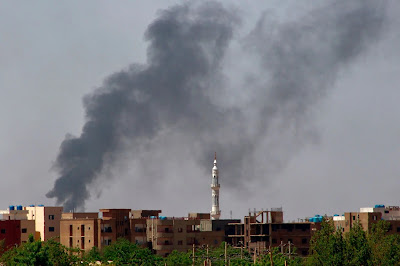
Image Smoke billowing in Khartoum on Wednesday. Credit Agence France-Presse — Getty Images.
Declan Walsh is the chief Africa correspondent for The Times. He was previously based in Egypt, covering the Middle East, and in Pakistan. He previously worked at The Guardian and is the author of “The Nine Lives of Pakistan.” @declanwalsh
A version of this article appears in print on May 20, 2023, Section A, Page 1 of the New York edition with the headline: Fleeing Envoys Trap Sudanese In a War Zone.
- A Rescue Operation: As feuding generals turned Karthoum into a war zone, two university students navigated a battered Toyota through the chaos and saved at least 60 desperate people.
- Fleeing Sudan: The violence has driven thousands of Sudanese into neighboring countries and caused an exodus of diplomats and other foreigners who were in Sudan when violence erupted.
- A Safe Haven, for Now: Egypt has relaxed border controls for Sudanese arrivals since the outbreak of the fighting. But officials, expecting busloads of poorer refugees to follow, worry about what comes next.
- A Failed Test: As the crisis in Sudan creates the kind of power vacuum that the United States had hoped to avoid, critics of the Biden administration are blaming a naïve approach to foreign policy for the violence.
View original: https://www.nytimes.com/2023/05/19/world/africa/sudan-us-embassy-passports.html
COMMENTS POSTED AT ARTICLE ABOVE
Sort by: Newest
—
San Diego
May 20
So the Chinese Embassy retained and protected the passports they held for Sudanese. We did not. Two thumbs up for the Chinese. One down for us. Reflects our cavalier attitude.
123 Recommend
—
Rhode Island
May 20
Horrifying, and should be prosecuted, but of course never will. It was not U.S. property to destroy.
76 Recommend
—
NJ
May 20
It was my understanding, from NYT reporting, that American dual citizens were given quite ample notice to leave ASAP and that some, having various family and financial connections to the country decided to stay: if that truly is the case, then sadly, this is on them, not the embassy staff.
35 Recommend
—
USA
May 20
Frankly, I don’t know why these people waited so long to leave the country
21 Recommend
—
SFNM
May 20
Gut wrenching. Have we learned nothing?
20 Recommend
—
New Delhi
May 20
The State Department abandoned U.S. citizens in Sudan while crowing about getting their own folks out. No surprise that they shredded the safety of so many Sudanese who put their faith in the power and fairness of the United States. We have lost the trust of the world in so many ways large and small. We could have made better choices.
72 Recommend
—
Living In Mexico
May 19
Sounds like there need to be changes to these protocols so that certain items, including the passports of non-US citizens, get taken with evacuated diplomats. I get that there’s only so much room on a Chinook. But it should be possible to calculate what is practical and design suitable emergency protocols. This has already happened at least twice and it will happen again.
On a more practical note, does Sudan still have embassies in the US, in DC and at the UN in NY? If so they could reissue passports and people approved for travel to the US could pick them up when they get here. It sounds like the numbers involved are small enough for this to be a real solution to this specific problem.
135 Recommend
—
North America
May 19
With the technology available, it should not be necessary to take people’s actual passports away from them. These people came to us for help and we made things more difficult for them.
140 Recommend
—-
james commented
May 20
@Bwspmn
Set a blame in the US why don’t you blame the warlords that are tearing the country apart?
30 Recommend
—-
Philadelphia, PA
May 19
It seems highly unlikely that the details of visa applicants were not routinely sent to the home country for review, so each country should at least have been able to generate a list of people it had a moral responsibility to rescue.
49 Recommend
—
Boston
May 19
Having the passports fall into the wrong hands, to be misused by the wrong persons for travel to the US or other countries, would be an ongoing security risk. There could also be danger or persecution of persons who were identified as having relations with the US, so destroying the passports does make some sense. How much better to have scanned them and then taken the physical documents when evacuating. What more important items could there be when getting people to safety?
75 Recommend

.jpeg)